Goldex Casino Payment Methods in Australia
 Available in US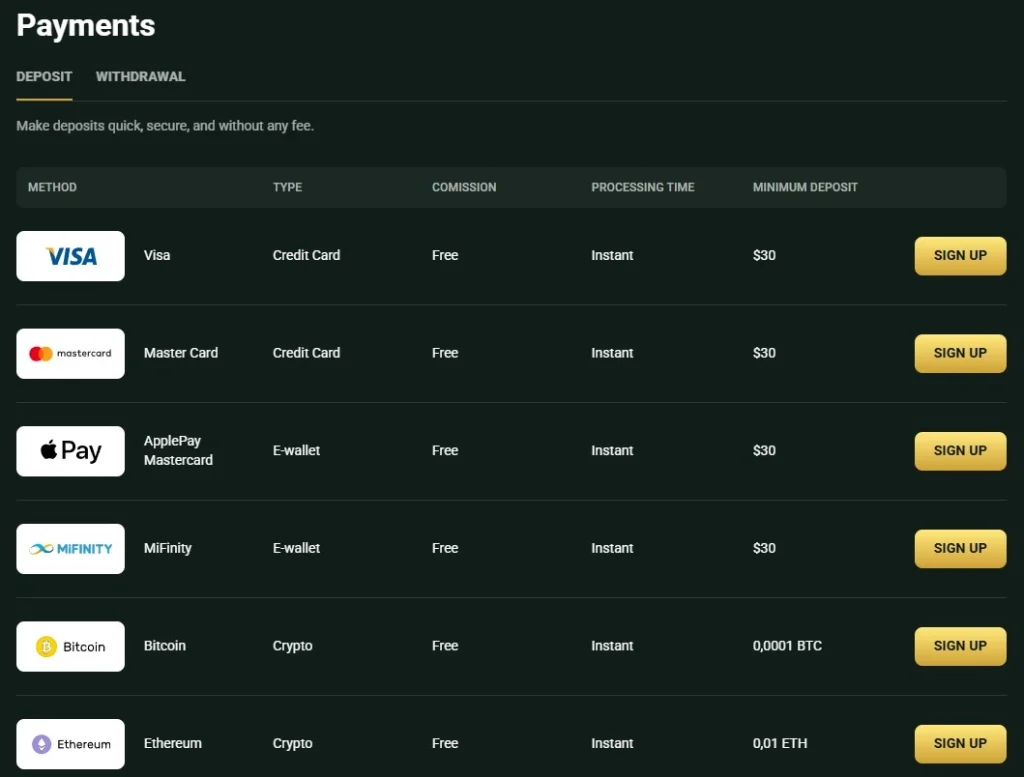
Goldex Casino Australia Guide
Payments guide
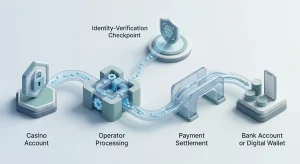
Goldex Casino supports AUD as an account and payment currency, and its current English-AU terms set the minimum deposit at A$30. The operator’s payment catalogue includes cards such as Visa and Mastercard, bank transfer, e-wallets including Skrill, Neteller, MiFinity and MuchBetter, plus cryptocurrencies such as Bitcoin, Ethereum, Litecoin and USDT. The important distinction is that currency support is not the same thing as guaranteed method availability. Goldex tells players to check which methods suit their country, and the cashier is the account-specific view of what is actually available. Australian users should therefore treat the public payments page as a catalogue of supported categories, not as a promise that every listed rail will appear in every account. Exact cashout limits and timing are covered in our withdrawal limits and times.
Table of Contents
- What is verified for an Australian AUD account
- AUD support is different from payment-method support
- Cards: Visa, Mastercard and Maestro
- E-wallets and bank methods
- Goldex crypto support
- The own-name payment rule
- Why the cashier is the final availability check
- Deposits versus withdrawals
- How to compare Goldex payment options without overreading the list
- Bottom line
- Goldex Casino Payment Methods in Australia
What is verified for an Australian AUD account
The current Goldex English-AU terms explicitly list AUD among accepted currencies and set A$30 as the minimum deposit. Those are Australia-specific numbers. The global Goldex payments page separately shows a broader method catalogue that includes card, bank, e-wallet and crypto options. Together, those sources distinguish Australia-specific currency and minimum-deposit terms from the broader payment catalogue.
| Payment point | What is verified | How to interpret it |
|---|---|---|
| Account currency | AUD is supported | You can use an AUD-denominated Goldex account rather than treating EUR or USD as the default reference currency. |
| Minimum deposit | A$30 | This comes from the current English-AU terms and is the relevant general deposit floor for Australian users. |
| Cards | Visa, Mastercard and Maestro appear in the operator catalogue | Check the cashier for the card options actually enabled for the account. |
| E-wallets and bank methods | Bank transfer, Skrill, Neteller, MiFinity and MuchBetter are listed examples | The public list establishes supported categories, while account availability is provider and country dependent. |
| Crypto | Bitcoin, Ethereum, Litecoin, Bitcoin Cash, DOG, USDT, BNB, ADA and TRX are accepted currencies in the AU terms | Use representative currencies for comparison and confirm the live cashier before transacting. |
This separation matters because a method can exist on the operator’s platform without being enabled for a particular country, account, issuing bank or payment-provider route. Goldex supports the listed payment categories, but that does not guarantee that every row in the global catalogue is available to every Australian user.
AUD support is different from payment-method support
AUD support answers a currency question: can the account and transaction values be denominated in Australian dollars? Goldex’s AU terms answer yes. Payment-method support answers a different question: which rail can be used to move funds into or out of the account? That answer depends on what appears in the live account flow.
This distinction is especially useful when comparing online casinos. A site can support AUD but still have a narrower set of Australian payment rails than its international payments page suggests. Conversely, a payment provider can appear globally but be unavailable for a particular account because of country, issuer or provider rules. The cleanest check is therefore two-stage: verify the currency in the AU terms, then verify the actual method in the cashier.
Cards: Visa, Mastercard and Maestro
Goldex’s current public payments catalogue lists Visa, Mastercard and Maestro among deposit methods. For Australian readers, the safe conclusion is that card payments are part of the operator’s supported payment stack. It is not a guarantee that every Australian-issued card will work. Issuing banks and payment processors can approve, reject or restrict transactions independently of the casino’s public method list.
The A$30 minimum deposit comes from the AU terms rather than from the global payment table, so that is the figure to use when thinking about an AUD deposit. The same terms also require deposits to come from a payment method registered in the player’s own name. That own-name rule is more important than the logo on the card: using someone else’s card or account conflicts with the operator’s payment policy.
If your main question is whether a deposit qualifies for the site’s welcome sequence, keep the payment rule separate from the promotion rule. The bonus deposit requirements explain the current welcome stages and their own conditions. A payment method being available does not by itself make a bonus applicable.
E-wallets and bank methods
The public Goldex catalogue includes bank transfer and several familiar e-wallets. Verified examples include Skrill, Neteller, MiFinity and MuchBetter. These names show the range of rails the operator integrates, but the account cashier remains the deciding surface for a specific Australian user. That is where country and provider availability becomes concrete.
For a practical comparison, focus less on the number of logos and more on the role each category plays. Cards can be familiar for deposits. E-wallets can keep casino transactions separate from a primary bank card. Bank transfer is a direct bank-based route and can have a different settlement profile from wallet methods. Those are category differences, not promises about speed or cost for a specific Goldex transaction.
No universal fee claim is established for those methods. Public payment tables can change, and fees can also arise outside the operator, for example through banks or other intermediaries. The live cashier and the user’s own payment provider are the relevant places to inspect the actual transaction conditions before confirming a deposit or withdrawal.
Goldex crypto support
Goldex’s English-AU terms list several cryptocurrencies among accepted currencies: BTC, ETH, LTC, BCH, DOG, USDT, BNB, ADA and TRX. The public payments page also shows major crypto methods such as Bitcoin, Ethereum, Litecoin, Bitcoin Cash, Dogecoin and USDT. That gives solid evidence that crypto is a supported payment category.
Representative currencies are more reliable than treating today’s public list as a permanent exhaustive inventory. Crypto payment menus can change as processors add or remove assets. Bitcoin, Ethereum, Litecoin and USDT cover distinct examples of the operator’s current support without implying that every listed token will remain available.
Goldex’s terms also state that the casino does not provide a currency exchange service. That matters when comparing fiat and crypto funding: a casino account is not a general-purpose exchange wallet. If a player wants to use crypto, the transaction should be considered as a payment into the gaming account, not as a route for converting assets between fiat and crypto.
The separate recurring-promotions page covers promotional mechanics connected with crypto. The payment method itself is separate from any bonus offer attached to it.
The own-name payment rule
Goldex’s current terms prohibit third-party payments. Deposits must come from a bank account, card, e-wallet or other payment method registered in the player’s own name. This is a concrete account-control rule, not a generic recommendation. It affects how someone should prepare before depositing.
For example, a shared household card, a friend’s wallet or another person’s bank account is not interchangeable with a payment source held in the registered player’s own name. Even when a transaction technically reaches the merchant, it can create a conflict with the account terms. The sensible setup is to keep the account identity and payment-source ownership aligned from the first deposit.
That same principle becomes relevant during account checks and cashouts. Our account requirements explains registration and verification as a separate topic, while withdrawal rules cover the payment consequences in more detail.
Why the cashier is the final availability check
The operator itself directs players to ask about the payment methods most suitable for their country, and the selected payment method displays its own maximum deposit or withdrawal where applicable. That design means the live account flow contains information a static public list cannot fully represent.
- Set or confirm the account currency as AUD.
- Open the deposit or withdrawal section of the cashier.
- Check which methods are actually displayed for the account.
- Read the minimum, maximum and any method-specific information shown before confirming the transaction.
- Use a payment source registered in the account holder’s own name.
This approach also avoids a common Australian comparison error: assuming that a locally popular method must be supported simply because it is common elsewhere. Goldex’s current public payment information does not establish PayID support, so PayID should not be assumed to be available.
Deposits versus withdrawals
A payment method that works for a deposit does not automatically tell you the complete withdrawal policy. Goldex’s AU terms contain separate cashout rules, including a minimum withdrawal, standard and VIP limits, processing stages, KYC-related holds and method-specific maximums. Those figures are covered separately because they apply to cashouts rather than deposit-method selection.
If cashout mechanics are your deciding factor, use the dedicated cashout guide. If you are still comparing the brand at a higher level, the Goldex Australia review brings payments together with bonuses, games, mobile access and account considerations.
How to compare Goldex payment options without overreading the list
Start with the facts that are stable enough to act on: AUD is accepted, the current general minimum deposit is A$30, Goldex supports card, bank, e-wallet and crypto categories, and deposits must use a payment source in the player’s own name. Then treat the live cashier as the point where a category becomes a usable method for that account.
For mobile users, the same logic applies even when the transaction is initiated on a phone. The question is not whether a payment logo appears on a general webpage, but whether the method is available in the account flow on the device being used. See the Goldex mobile for the broader mobile experience.
For operator and regulatory details outside the banking scope, see the licence and regulatory context page.
Bottom line
Goldex has a broad payments stack, but the useful Australian answer is narrower and more precise. AUD is supported, the English-AU terms set a A$30 minimum deposit, and verified categories include cards, bank transfer, e-wallets and several cryptocurrencies. The global catalogue gives concrete examples such as Visa, Mastercard, Skrill, Neteller, MiFinity, MuchBetter, Bitcoin, Ethereum, Litecoin and USDT.
The final method choice should come from the live cashier because method availability can differ by account, country and payment provider. Use the public catalogue to understand the range, use the AU terms for Australian figures, and use the cashier to confirm the method and conditions attached to the transaction you are about to make.